Hacking Gen Z Attention For Tech Courses – Cleancode IT Hub
Selling technical training to young audiences is not just about having a strong curriculum. For Gen Z and young professionals, the real battle is fought in the first two to three seconds of an ad — if it looks like a typical corporate promotion, they scroll past without a second thought.
Cleancode IT Hub, a premier training institute offering specialized IT and SAP courses, partnered with Musing Quills to solve this exact problem: how to disrupt Gen Z’s scroll and convert that attention into serious course enquiries.
Client Overview:
Brand: Cleancode IT Hub
Category: IT & technical training (including high-demand SAP courses)
Audience: Tech enthusiasts, fresh graduates, and young professionals looking to upskill and secure placements in the IT sector.
Cleancode already had:
Strong course offerings tailored to market demand
A clear value proposition around employability and specialised skills
A young, tech-savvy target audience that lived on social platforms.
What they didn’t have was ads that matched how this audience actually consumes content.
The Challenge: The Death Of The Boring Corporate Ad
Traditional training ads are typically:
Static banners with lots of text
Generic visuals showing classrooms, laptops, and corporate icons
Heavy on course names and bullet points, light on story.
For Cleancode’s audience, this format is invisible.
As the brand observed and Musing Quills validated:
Gen Z is entirely blind to traditional, text-heavy corporate ads.
If an ad “looks like an ad,” they will scroll past it in milliseconds, regardless of how strong the underlying offer is.
The objective was not just to run Meta campaigns; it was to:
Create an ad ecosystem that could violently interrupt their scrolling patterns, hold attention long enough to deliver the pitch, and drive meaningful opt-ins for Cleancode’s courses.
Strategic Approach: Native, Pattern-Breaking, Multi-Variant Creative
Instead of trying to “tune up” the existing corporate-style messaging, Musing Quills and Cleancode agreed on a bolder route:
Abandon the traditional playbook entirely.
The performance strategy revolved around three key decisions:
Multi-variant creative testing
Conceptualise five distinct ad copies, each designed to attack the attention problem from a different angle.
Treat creative ideas as hypotheses to be tested, not as one big “best guess”.
Speak their digital language
Borrow directly from how young users already consume content: viral hooks, meme energy, and daily vlogs, instead of polished corporate templates.
Make the ads look like content, not ads
Use formats that blend seamlessly into the feed so users don’t mentally reject them before watching.
This translated into a two-format creative system:
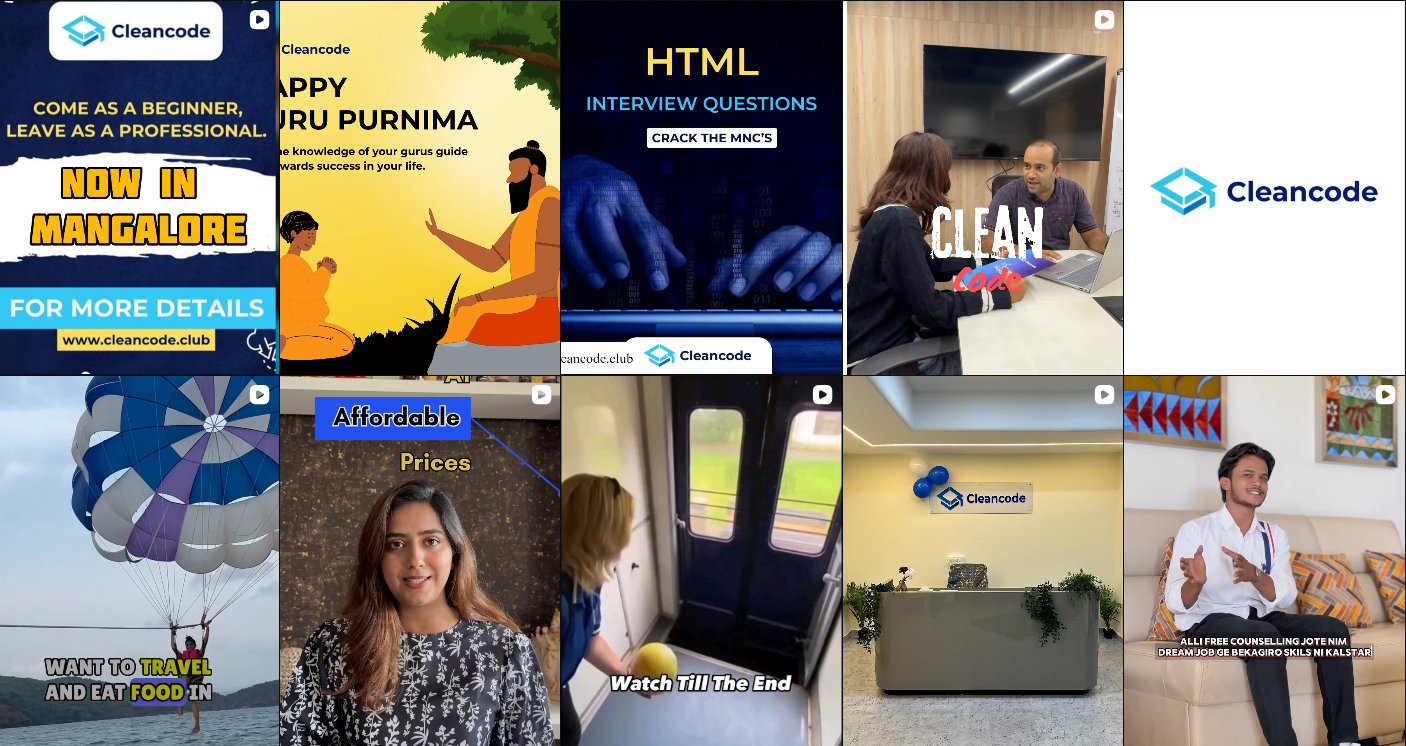
Three “viral hook” ads
Two daily vlog–style influencer ads
Creative Format 1: Viral Hook Ads
Goal
Grab attention immediately, keep viewers watching till the final message, and then land the pitch for Cleancode’s courses.
Tactics
For the viral hook ads, Musing Quills:
Used high-curiosity visual pattern interrupts, the kind of opening frames that make users pause and wonder what’s happening.
Explicitly instructed viewers to “Watch Till The End”, leveraging call-outs that are native to short-form video culture.
The psychology behind this:
Strong hooks + explicit watch-till-end prompts tap into curiosity and completion bias.
When done right, users voluntarily watch the full 15–35 seconds, giving you enough time to introduce the problem, agitate it, and present Cleancode as the solution.
The content itself wasn’t about listing modules and fees. Instead, it leaned into:
Relatable tech struggles (e.g., feeling stuck, not getting calls from IT companies, wanting to break into SAP or specialised IT roles)
Emotional triggers around career anxiety, peer comparison, and future-proofing skills.
The course pitch was delivered only after attention and emotional relevance were secured.
Creative Format 2: Daily Vlog–Style Influencer Ads
Goal
Deliver the full course pitch inside content that feels like a normal vlog, not a formal advertisement.
Tactics
For the two influencer-led ads, Musing Quills:
Partnered with creators whose daily vlog style already resonated with Cleancode’s target audience.
Seamlessly integrated the Cleancode course message into that vlog narrative, so the “ad” felt like a natural part of the content.
The execution looked like:
A day-in-the-life or lifestyle vlog where the influencer’s routine touched on studying, working, or aspiring to break into IT.
Within this “normal” flow, the influencer organically talked about Cleancode’s courses — why they chose them, what skills they’re gaining, and what outcomes they’re aiming for.
This native camouflage meant:
Users watched the pitch before consciously realising it was a sponsored enrollment drive.
The content felt like real advice from someone they follow, not a “cold ad” from an institution.
It’s a textbook example of matching creative format to platform culture, something performance best-practices increasingly emphasize.
Psychological Triggers At Play
Across both formats, Musing Quills deliberately combined:
Pattern Interrupts – Visual or narrative openers that don’t look like typical ads, forcing a pause in the scroll.
Native Language & Aesthetic – Using the same pacing, humour, hooks, and framing that the audience is used to consuming from creators they already trust.
Narrative Before Offer – Building tension around the audience’s current pain (stagnant career, irrelevant skills, lack of placement opportunities) before positioning Cleancode as the tool for change.
Social Proof & Relatability – Influencers and scenarios that feel “like me”, rather than aspirational corporate clichés.
By aligning creative decisions with how young people’s attention and trust actually work, the campaigns made technical training look culturally relevant and emotionally urgent, rather than dry and distant.
Results: 7x Improvement Over Previous Campaigns
The shift from stiff, corporate-style ads to native, viral-style performance creatives had a dramatic impact.
According to your campaign data:
The new ad copies completely shattered all previous benchmarks Cleancode had recorded on its past campaigns.
The performance of this creative strategy was 7x better than any prior campaigns run on Cleancode handles.
While the document doesn’t list specific CPL or ROAS values, a “7x better” outcome in this context typically shows up as:
Significantly more leads or enquiries for the same budget,
Or the same number of leads at a fraction of the cost,
Paired with better in-account efficiency signals (higher engagement, better watch times, stronger click-through rates).
The important business takeaway:
The style and delivery of the creative proved to be just as important as the product itself when it came to capturing attention and driving enrollment.
Cleancode didn’t change its course offering. It changed how that offering was presented — and performance followed.
Business Impact For Cleancode IT Hub
The campaign did more than bump a few metrics:
It demonstrated that Gen Z and young professionals will pay attention to serious training offers — if those offers are wrapped in content that respects their media habits.
It gave Cleancode a repeatable creative blueprint:
Multi-variant testing,
Viral hook frameworks,
Native influencer integrations.
It future-proofed their marketing approach by proving that performance isn’t just about budgets and targeting; it’s about creative that belongs on the platform.
Most importantly, it provided the institute with:
A sustainable way to keep pipeline full for high-demand courses like SAP and specialised IT tracks.
An approach that can be updated and iterated each quarter with new hooks, new vlogs, and new angles — without reverting to the old corporate style.
Strategic Takeaways
When you describe this case study on your Performance Marketing service page or in pitches, you can highlight that:
For youth-focused education brands, “ad that looks like an ad” = death. Native formats outperform corporate ones by a wide margin.
Creative strategy must be treated as a performance lever, not a cosmetic layer. Cleancode’s 7x lift came from creative thinking, not just media tweaks.
Multi-variant testing — in this case, 5 distinct ad concepts — is a practical, ROI-driven way to discover what your audience truly responds to.